firms that are losing interviews before
they're even
shortlisted is because they're not
pre-positioned in somebody's mind as the
right firm for the job.
So if you if you don't have the body of
work and the examples and the people with
the right resumes and and you're not
telling the market this is the kind of
work that we want to do,
having a prettier logo is not going to
save you. Having a prettier website is
not going to save you.
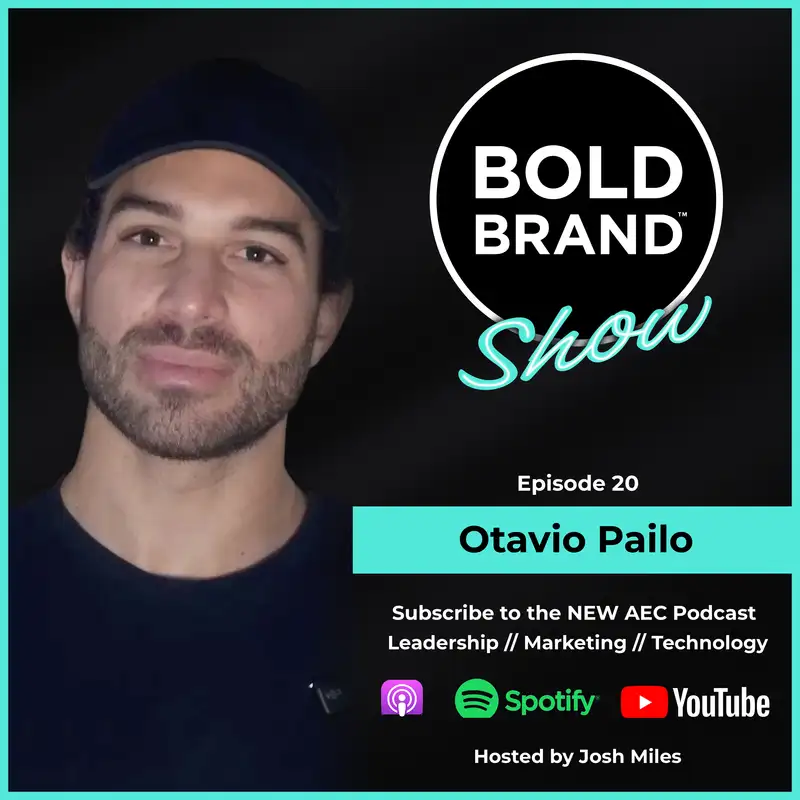
Welcome back to the Bold Brand Show. This
week we've got something
a little bit different.
Our special guest today is actually me.
Otavio had me on his alreadybuilt.ai
podcast and is allowing me to share this
episode with our audience here as well.
So as maybe a little special thing for
today's my 50th birthday, I hope you'll
enjoy this interview with yours truly.
Josh, thanks for being on the show.
Appreciate having you on.
Yeah, I appreciate you reaching out and
it's cool to find a new platform.
Yeah, absolutely. It's really interesting
to look at your career.
Like you built a really unique track
record where you kind of have this
interesting take on like marketing and
branding meets the AEC world.
And from what I understand, like you ran
a potentially like a full service agency
for over 15 years, ended up selling it.
Then you ran marketing at SMPS and then
now you have, you know, I can see your
logo on the back there, bold and bold
brand and bold brand 2.0.
And you run a show, you essentially run
this branding and
video agency for AEC firms.
And so it's cool to see that you yourself
have seen both the inside of what these
engineering firms kind of get shortlisted
on, what drives them getting new clients.
And you have perspectives on being a
generalist or kind of niching down on
different types of expertise.
And so, again, thanks for being on the
show and super excited to have you here.
Can you take me back to kind of like the
agency that you ran, like what, 16 years?
Like what made you decide to sell it and
kind of move on something else?
I think life was kind of falling apart
around me when I started that firm and
was running it, especially in the early
days, if somebody was like,
"Would you ever consider selling or
leaving it at some point?"
And my half serious joke was like,
"You're going to have to pry this thing
from my cold day pants."
Turns out I stepped away from it pretty
easily just with all the
life things that were happening.
And the timing turned
out to be pretty good.
COVID happened a few years later and it
was nice to not have 20 people that I was
responsible for
during that period of life.
But yeah, it was awesome growing it.
I was sitting around a campfire with a
friend of mine a couple of
years later and he was like,
"Do you ever want to do it again? Don't
you know that if we did it again, it'd be
so much easier, so much
faster. We grow it faster."
I remember telling him back then, I was
like, "I just don't think I
want to build the big team again.
I don't need that for my ego. I don't
need that for my life
goals. I've done it."
And it was cool. It was fun. The people
were the best part of the agency.
Growing that team and seeing the places
that they've grown onto and started their
own businesses and done all these other
really exciting things.
That is certainly the most proud thing I
have from my first agency.
That's awesome to hear. Personally, I
have a similar goal for my company. One
of the things I want to do is
enable individuals that are fresh out of
undergrad who might not necessarily know
what they want to do,
but they're really sharp, intelligent.
They pick things up fast and just give
them resources and skills that
they can grow their own network and their
own careers and do
really impactful projects.
Once you figure out what you want to do,
you're ready to go and
enable them to grow forward.
One of the things that I know you said is
that the more that agency grew, the
further you got from the actual work.
What did that actually look like in
practice? Was the actual work just
delivering to your clients or
being face-to-face and just becoming more
of an internal ops guy?
Yeah, so that agency started. Largely, we
were doing logo and website
work in the branding space.
We worked for the three-legged stool, as
I like to say, was AEC firms, software as
a service, and non-profits.
Because so much of our work was
design-oriented, when I
started the firm, it was just myself.
My first hire was a designer. My second
hire was a designer. My
third hire was a designer.
That went on for many hires before I
brought on an account service person or
an operations person
or anything that wasn't design-oriented.
So it was very design-focused.
But as you grow a design firm,
eventually you need somebody just out
there bringing a new
business. There really wasn't
anybody more likely to be the new
business person than myself. So the more
I would bring on a bigger
team, the more I was relegating myself to
just a new business and
sales role, which wasn't all bad.
I loved that part of the project, helping
find really great clients
for the firm to work with
and helping those clients figure out what
they needed to grow and to
make their businesses more
successful was also really cool. So it
wasn't so much that I was
selling as to help clients figure
out what they needed and to get them in a
good spot. I was really
proud of the team that we had
and really proud of the work that we were
doing. So it was an easy
sale. But yeah, at the end,
I was really kind of out of the creative
work and we weren't really doing any
video or photography
work in-house at that point. That's
something that I picked up after I left.
And now video is 40% of my work
today. Some years it's more like 50 or
60. And it's really cool to have my hands
back in the creative
product. So I'm not just the sales guy. I
get to actually do the
work. And as I like to tell my
clients to have the senior talent that
you meet with is also the
senior talent you get to work
with on each project. So that's a pretty
special thing too. Is that
how you would approach? Let's
say if you did rebuild the agency, would
you approach it almost
in reverse for you? Let's
say hire a few designers, a few
videographers, and then bring in someone
to just kind of manage the
kind of back office work so that you can
stay in the creative side?
Is that what you're doing now?
Yeah, I guess if I were to do it over in
2002 terms, that might
be what it looked like.
In 2026 though, I feel like I have all
the advantages that a
big firm would have, but
I have all the advantages that I have no
full-time overhead in that
same sense. So that I can go. In
2002, if you wanted to grow an agency,
you had to put people in seats under the
roof in a cool office,
in a cool space, in a cool city with a
great culture and all the
things that happened right
there. Because nobody who was really
talented was really doing
remote work. Or if they were,
really the cutting edge, bleeding edge
folks who are comfortable with being
solo, working from home,
or being a digital native. If anybody was
doing that in 2002, it was pretty rare.
In 2026, there's a lot of super, super
talented people who don't
want a full-time job, who
certainly don't want to have to go into
the office every day,
and they don't want to be
chained to one location, one market, one
company. And so it's really
easy for entrepreneurs today
to get a network of the best talent in
the world, really. I mean,
you could work with anybody that
you want to, and they can be anywhere at
any time. You can bring
them on for every project,
you can bring them on for one project,
you can bring them on for
three a year. You get to decide
how that works, and they get to decide
how that works too.
So it's just less of a,
everything's got to be kind of carved in
stone situation and more
of like, you just get to be
flexible and work with the right talent
that you want for the right
project, and you're not tied
to anybody else otherwise. I think it's
such a cool thing that I,
I mean, I'm a young guy,
like I didn't experience like what it was
like before, but I very
quickly like recognize just
talking to people that have run types of
agencies in the past that the level of
flexibility that you
have, especially when it comes to how you
structure like the
incentives for each job,
each project, not only allows you to kind
of reduce like the risk and the overhead,
but it allows you to package it in a way
that the best talent
actually wants it because they're
confident that they can actually deliver
on what it is. And so
it's almost like this, like,
like a profit sharing kind of thing where
I don't know if you've seen
like that kind of trend of,
you know, A plus quality talent is going
to do 5x what B
talent would be able to do,
but you're also going to have to pay them
accordingly as well.
There's, there's a handful of other, you
know, solo preneuers that I
collaborate with regularly. So
it's, it's really fun when you get to
bring two or three of those kind of A
players together to work
on the same client. Usually one of us is
kind of like the main
agency or the kind of owns the
client relationship and the others are
there to help. And then when we go to
work on their client,
that's the flips, right? So like I get to
support them, they get to
support me. It's, it's just a
really special way to, to do things. And
it's, you know, it is
different than how my, my old agency
operated, but you know, it's different
times and, you know, different
priorities and all the things
that really changed. But I think it
works. It works great because everyone's
incentivized for the best
outcome for the clients. Like the way I
always thought of it is
just optimized for great case
studies and whether you have partners,
you know, we work with like a lot of like
different fractional
leaders sometimes because the way our
business works is we go in,
find the core bottleneck of
the business and like 70% of the time has
nothing to do with AI. So
we're not going to go and
implement a solution that doesn't
actually solve the bottleneck, but it
might be like a key hire.
And so we go talk to people or it could
be something like on, you
know, the, the positioning
of the company itself. Yeah. Yeah. Yeah.
So you led a little more on
the marketing side. So you
led marketing at S and PS. What did that
teach you that kind of, you
know, running an agency for
AC firms, like didn't actually translate
as much. Like what, what,
what did you pick up new while
marketing there? Yeah. My, my S and PS
story is so interesting in
that S and PS is a big piece of
the reason as to why I got so in deep
with AC firms. So we, we
created a website at my first
agency probably in 2010 that won a
national S and PS award in
2011. All of a sudden we had
all kinds of engineering and architecture
firms who were interested
in how do I get a website?
The one that you made. Um, and that
attention was coming from all
around the country. And at the
same time, I was kind of thrust into the
speaking circuit with S and
PS. So I was speaking a lot of
chapters and regional and national
conferences. Um, so I get to
meet tons of members and create
relationships and friendships that I
still have today. Um, so I
went from this like outsider to
a volunteer to a speaker to, uh, you
know, a regular attendee and a, and a
member and a volunteer,
all the things. And, uh, right before I
took the job with S and
PS, my agency pitched and won
the work to rebrand S and PS. So we
started the project where I
was the sales guy and we finished
the project where I was the client no
longer the owner of the
agency. So it was, it's a really
surreal experience to be kind of on both
sides of that. But, but the
experience of being at S and
PS, um, you know, the headquarters are in
Alexandria, Virginia,
just outside of Washington,
DC. And I was working remotely, largely
from my old place in
Indianapolis and, uh, you know,
travel a lot for conferences. I was out
meeting with a lot of, um, a
lot of the firms in different
markets and going to different chapters
and all the things, but it is such a
different experience
when you are, um, some would find that
really intimidating to do
marketing for an organization
of marketers. Um, there's a lot of
potential pressure there.
Um, so, you know, for me,
I just to keep myself saying, I had this
big whiteboard at home and
I was all the things that
I wanted to accomplish while I was at S
and PS. Um, and once that
whiteboard started getting
mostly crossed off, that's when I was
like, okay, I think I've, I think I've
served my purpose here.
I think it's time for me to, to move on
and the entrepreneurial itch
was starting to scratch again.
So it was, it was time for me to, to do
something different. That's so
interesting. I never hear
of anyone just having like almost like a
to-do list for a role, like
what they want to accomplish
at a company. The only, the only thing
I've heard, I've heard of this in the
tech industry before
where people will come in and they'll
revise something internally
for like, let's say a product
and then the only, because they were just
bugged by that thing. Yeah.
Yeah. They're like contractors,
stuff like that. But that must have been
really daunting because
the way I imagine it is like,
if my company wanted to go in, like help
anthropic build out
some sort of internal AI
harness, I'm like, why aren't we
surrounded by all these
experts in the field? Like why,
why would they just do it themselves?
But, um, but I mean,
imagine if you could, so like, um,
SMPS was an organization that I admired
and I, I feel the same way
about the SMPS project as I
do about some of my favorite clients,
which is, um, the
experience of working together,
the culture, all the things internally
about SMPS were great and the
external facade, the rapper,
the, the, you know, corporate identity,
the, the way that we talked about
ourselves, the website
experience, I felt like all those things
felt dated. They just
didn't reflect who SMPS was on
the inside. An SMPS meeting is like going
into a room where
everybody knows everybody and it's
really warm and it's really welcoming
where people know that they
can, can team with one another or
they can collaborate on projects
together. You walk into an
SMPS meeting, it's usually loud.
It's fun. Uh, and the old identity felt
stale and stodgy and serious and
corporate and all the
things that just weren't the right fit.
So that's what made it great
for me is to step inside of an
organization that I already loved and
admired and to help them
like really step into their own.
And then once I had done the job, I was
like, okay, I don't need to, I
don't need to stay around and
babysit this thing. We've already done
the work and I'll pass
the torch to somebody else.
That's awesome. So you won that award for
the SMPS kind of a
website and then all of a sudden
you have this new lead flow coming in
asking for essentially, you know, a
carbon copy of like,
can you do the exact same thing that they
just did? Yeah, quite
literally. But I have a website
just like that. No, is the answer. Right.
Because you have the, you
have this line where, you know,
if someone else can just put the same
exact headline on the
website, you should probably be
rewriting it. Why is it that so many
engineering firms and AEC
firms like come in and just kind
normalize towards the mean and kind of
just end up looking and feeling the same.
And what like, how did you communicate
that to these potential
leads coming in? They were like,
we want this exact same thing. You're
like, no, here's why. Like,
what would you like? What did
you say to that? Yeah, there's so much to
that. First of all,
marketing in the professional
services world is still a pretty brand
new industry. It was
unethical or illegal to market
as late as the 1970s. So S and PS was
formed about 52 years ago now, I think.
So that was kind of the
birth of marketing in the professional
services and trying to bring
that into the light is like,
Hey, this is an okay thing that we tell
people and explain to people
what we do and why we do it,
how it's going to be different. So part
of the reason why I
think so many firms are still
differentiated is we don't have hundreds
of years of examples of how to do
marketing in the space.
The other thing is good news or bad news.
Firms in this world tend to be
multi-generational and
they last a long time. So, you know,
we've got firms in the US that are 50,
70, 100 plus years old.
There's a lot of kind of momentum
culturally that happens with that. And
what gets baked into that
is that we've always done things. And
also good news, bad news,
doing good work is how you used to
win more good work. And it's still part
of it, but it's not the
only part because as younger
generations come up and, you know,
millennials and Gen Z's and soon to be
Gen Alpha, they look for,
they research, they buy very differently
than even the Gen Xers did. And we
thought we were doing it
really differently. And the Boomers
certainly and relationships older than
that, it was all about,
you know, who you know in the
relationships and relationship is still
so important, but the
differentiation and standing out and
really doing something
different has got to be more than we
have the best people and we do things on
time and on budget because literally
every other firm can
say that. So if your firm is standing on
the things that anybody else
could say, if that headline,
like you said, could be on anyone else's
website, then that's
probably not good enough. Like the
you got to have something that really
helps define who you are as a firm and
what makes you different.
What are the other components outside of
the headline that kind of
make up that brand identity,
or at least the ideal brand identity?
Because another thing
you've said is, you know, that
5%, like what's the other 95% of it? I
think the positioning is
you alluded to a minute ago is
probably the most important thing. So
how, who are we going to serve? How are
we going to serve them?
What makes us different? And there's a
lot of other things that go
into your positioning, but
firms that are losing interviews before
they're even shortlisted is because
they're not pre-positioned
as the right firm for the job. So if you
don't have the body of
work and the examples and the
people with the right resumes and you're
not telling the market,
this is the kind of work that
we want to do, having a prettier logo is
not going to save you. Having a prettier
website is not going
to save you. And having a website or
marketing collateral that
talks about you like any other
generic firm is certainly not going to
help you be seen as a
specialist. So if let's say
I ran an AEC firm, would it be a case of
just niching down to one
specific thing or am I still
allowed to kind of do let's say like four
things separately? Because
I'll actually give you an
example, like my company, for the longest
time I was very
undisciplined. And so if you look at our,
you know, current website on I think we
have a page like our
approach where we talk about all
the different case studies we've done,
you'll see that we've worked with 15
different industries,
like across from like legal to, you know,
health techs to, you know, civil
engineering, AEC, MGA,
stuff like that. And only recently have I
niche down into focusing on
kind of like MGA insurance,
civil engineering, kind of technical
advisory kind of stuff, energy,
accounting and business
law. And like, it's just those four, and
that's it. And we have,
you know, separate vertical
specific pages and all that stuff. Is
that still too broad? You
know, what I would encourage any
firm and not just you specifically is you
can accept and do and
execute on the work, any work,
any client, any industry that you feel
like your team or your
expertise is a good fit for. Like,
that's great. Like do whatever you want.
But I think telling the
market the thing that you want
to be known for should be as tight as
possible. So for me, branding
and video for the AEC market,
is pretty tight. There's not a whole lot
of wiggle room in that.
However, I do occasionally
do work for clients that are outside of
that. And I do occasionally
do work that is not just brand
or video that still fits kind of the
marketing design space. But
again, I want the market if
they don't know anything else, if they
don't remember anything
else, I want them to remember
that super tight strike zone consultant
friend of mine named
Blair Enz calls out the wedge.
He's like, you know, if you look at a
triangle from the side, right? Like one
side of the triangle
is this big blunt thing. And if you hit
somebody with the, we do
this and this and this and this
and this for this person and this
company, and sometimes this and gosh,
this one time we did
this one thing, like you're like, I
don't, I've already, you've lost me
untitled me, right? You
hit me with the wall of all the things.
But if you lead with the
pointy side of the triangle of the
wedge, and you kind of jab somebody with
that first thing to start
with like, Hey, we do AI
engineering firms. Like, oh, really?
That's interesting. Well,
who else have you done it
for? And what other kinds of things do
you do? Like you get to
tell them all the same things,
right? But you've led with the thing
that's memorable. And, and
that makes all the difference
in the world about being an another me to
another forgettable firm or are you
somebody that's really
going to stand out? And it, and it
affects everything else
downstream, right? It affects
the sales motion, how you're going to
approach like building out your, you
know, your lead list,
how you're going to approach the
conversations, how you're going to
service the clients. Because
if like, for my example, implementing AI
successfully and
solving core bottlenecks,
you see similar problems all over the
space. And then there's the
little nitty gritty details,
especially in terms of like regulatory
environments that adapt it slightly. But
fundamentally, it's the core set of same
problems and that we can
solve it very well. But I think
right, it's like the it's that wedge that
if you specialize more,
it's a, how would you call it,
like a virtuous flywheel that just comes
from itself. And it
allows you to become better
because you only focus on solving, let's
say, AEC firms consistently
over and over and over again.
And so you start getting these like, I
don't know, like the the
nitty gritty details that
will add to differentiation. And I'm sure
case studies and, you know,
social media and how people
see yourself. They're like, Oh, you know,
Josh is the AEC guy.
Yeah, totally. And I think I've heard
Alex or Mosie put it
this way is like, you know,
think about how you're going to market
and pitch the product first,
like, okay, what's all the,
what are all the craziest things that I
would want to include in a thing, like
something that's such
a great product or service that somebody
in my space would be crazy
to say no to, like start with
that, and then build the thing kind of
backwards from there, as
opposed to like, you know, the
opposite of that is, you know, software
as a service companies or
AI companies who build the
thing before they see if anybody even
wants it. And then they're
trying to sell the thing that
solves the problem that nobody had,
right? Like, so that's, that is such an
awesome way to think
about like, what is a thing that would be
so exciting to get to
buy? And then like, how do
we build that? Or how do we build that in
the real world? What are the things?
Okay, maybe we can't
people fly and maybe we can't do, you
know, all the magical things
we would love. But what are,
what are all the benefits that we would
want from a product like
that? And then can we actually
build something to deliver on something
that we know people would
be really excited about?
Yeah, start. Well, what is it? I start
with an offer so good,
people feel stupid saying no.
Yeah, it's hard to build, like, and you
have to niche down.
Otherwise, it's too broad, too
generalist. Like, I would say that, I
don't know if you're familiar
with like, just like the legal
space, there's these larger incumbents in
the legal AI world, where
you have like Harvey and
Legora and stuff like that. And their go
to market strategy is terrific. Like
they, you know, started
very aggressively bringing in talent from
these larger like a
monitor law firms, and then they
kind of just disseminate across it. But
I'll tell you, like, as
someone who works with these firms
that they made these tools so
generalists. And it does a good job of
like, a good breath of work.
But if you talk to like, even a large
firm that has a very
specialized like M&A corporate practice,
or that works in, you know, legal for
like the energy sector or like
engineering, they're like,
this isn't specific enough, like we still
need to customize things in
house. You have your book,
and in your book, you talk about a
process called drive. Can
you walk me through that?
Yeah, so drive is like the basis of our
brand strategy process.
Drive is an acronym that stands
for discovery, research, insights, voice
and essence or brand
voice and brand essence.
Discovery is really just internal
research. So it's when I'm sitting down
with the clients and
the stakeholders and understanding, what
are all your thoughts and
dreams and hopes for this
company? And, and tell me how you see
yourself? Like, what are those things
that you would use to
describe what the firm is like? And then
research is just research. So
it's the outside looking in.
So it's what's on our website today? What
social media say? What,
what other assets can I look at
to learn about your firm? And one of the
most important pieces
of research is actually
interviewing clients and understanding
how they feel about a
brand. So when you say,
internally, we said these three things,
but externally, we heard
these four, and they don't
all quite line up, right? But those areas
where these two line up
both internally and externally,
those are some of the most sticky
messaging. And those are the kinds of
things that I want to bring
to a client in the insights part of the
process, which is we knew
this, they said that, look at the
momentum that we have here, but also what
are some of the things that
we would love to say about our
firm, or we would love the clients to say
about us that they're not currently
saying, and how do we
really leverage that? So then taking all
those findings, building
that into a story and how we
talk as a brand, a brand voice, and then
getting down to the essence
of what are the one or two
or three words that are really driving
what the brand is about. And
that kind of becomes the verbal
compass for everything that we create. So
that drive piece all
happens before there's any visual
changes, before there's a new logo, new
colors, new type base, new website, no
new video, you know,
the strategy is what drives everything
else going forward. So it's
really their goals guide the
way that it drives everything else. Yeah,
we do something very similar
on the ops and delivery side
for companies. What you said it's like,
like one to three words. Can
you give me examples of what
that looks like? Because I find it like
my brain is hard to like
process boiling down like the
essence of a company down to just one to
three words. Well, I'll
tell you the one word that is
not going to be the brand essence, but
maybe a good example is like every firm,
especially engineering
firms like to say that they're
innovative. So you could say that your
brand essence is all about
innovation, right? So the real goal is
how do we say we're
innovative without using the word
innovative, because it's almost
meaningless at this point. You know, is
it we're thinking about
what's next? Is it we're thinking about
what's the most
sustainable? What is really driving the
innovation within the firm? So getting
down to those one or two
or three words that really
guide how you write copy, they guide the
voice. I mean, I think
another really helpful thing is
finding like, what is the archetype of
the brand? Are you more of a, you know,
are you a rebellious
kind of brand? Are you more of a magician
brand? Are you more of a, an
everyman kind of brand? And
and so those, those two tools together, I
think help companies come
a long way, especially when
you can say like, okay, if you were going
to think of a famous person,
an actor, a celebrity, or a
character, like what would in that role,
what would that character say? If that
character is aligned
with your brand, what are the kinds of
things that that person or
that character would say? And it
really kind of helps you think of what
are the headlines? What's
the messaging? What's the tone
voice? What's the attitude of the of the
website or the videos? Okay, I that
sounds like something
I heard a while back where you can think
of if your company was a
character, like a person,
and they went to like a house party, like
what would people say
about them after they left? Or
like, what would they be doing? Or in
that house party? What do
you do you use the, like the
character or like, kind of like celebrity
thing a lot? Like what's
some of the, what's one of your
comparisons you've heard? So an
engineering firm client of mine, we
landed on, on Indiana Jones
for two reasons. And the duality of
Indiana Jones is why it was so cool. So
some of the work they do
takes them into wild places. And they
almost feel like that explorer side of
Indy who's getting into
maybe not getting into trouble, but you
know, putting himself in
places that are like, this is
real adventure. But also there's like,
kind of that professor side
of Indiana Jones, that's like
more, more studious, or, you know, comes
off a little more nerdy.
And he's like, really in the
books and the details and knows all the
facts and the figures. So to
create that kind of personality
for this engineering firm brand was
really cool. Because we could, we go back
to that and be like,
okay, which side of Indiana Jones is this
page about which is
what's the message about? And
how do we show both of those two? It's
playful, it's light, but he's
also like really sharp and he
knows his stuff. So like, how do we show
like, you're the likable
nerd, maybe is the right way
to say it. But, you know, when you can
grasp on, another client
was, was kind of a combo of, of
Ted Lasso and another character. So like,
to be able to say like,
okay, this is this, this likable
friendly guy who's also like, got this
every man serious quality to
him. So I, I find that super
helpful just for me when I'm advising
firms on, especially how to create
messaging and write copy.
And I, I think it works for them too, so
that they can put themselves in a similar
headspace when they're trying to
communicate. I wonder what my
company's character would be.
It's something I have to do out for the
show. Um, yes. I think it
also works like with the car
example too. Like that's sometimes it's
an easier place to start
when somebody's like, oh, I'm a,
you know, I'm a Ford F-150 or I'm a Tesla
or I'm a, you bug, or I'm a,
I'm a, I'm a Corvette or I'm a
McLaren. Like I'm just all power or, you
know, so getting to the car first might
help you get to the,
to the celebrity second. Okay. Okay.
Well, McLarens are cool, but
they're in the shop pretty often. And you
can find all those
parallels. So like really gets you,
you find yourself talking about your
company in the abstract, but
it kind of reveals some truth
about who you think you are. Right. Like,
like, well, I'm not that
firm because we're not always
in the shop or more reliable than that.
So what is, what's the powerful car
that's also reliable?
Let's go, let's go with Porsche. Um, on
like case studies and kind of
evidence, you, you also said
that like, you know, claims are
relatively cheap to make. And then
evidence is more of a brand asset.
This is something that kind of I struggle
with because due to the
nature of like who we work with,
a lot of times they don't want explicit
case studies associated
with them, especially for,
you know, due to bottlenecks, we drive
like financial results.
And especially if they're
a private company, they don't want
financial information
published, at least at, you know,
at the very least tied to them
specifically. And so we have to extract
some things and we can't be
as detailed as we want to. Um, is this
something that like
engineering firms have to deal with
where you can't just, you maybe you could
put out logos, like here's who we work
with, but you can't,
let's say this is what we did for them
specifically, or maybe you
can talk about case studies,
but you just can't tie it to them. Like,
how does that work in terms
of defining and separating
between like what's just a claim and
what's actual evidence that
you can use as a brand asset?
Well, I'll give you two sides of this
actually, because, um, a
client that I just did some video
work with, I'm currently under NDA for
that client. So until I
have their permission to share
who the client is, I can't even tell you
who it is. We'll tell you
they're in the engineering space.
And the interesting bit is that the
project, the main client
that they're working with
in this location that I worked on this
project, we can't mention
their client either. Um,
so it was especially tricky to say, you
know, really showcase
the expertise of the team
and the types of work that they do and
how passionate they
are about their expertise
and how they collaborate with their
fellow, um, employees across this broad
spectrum of work that
they're doing in this industry in which
we're not going to mention
the client's name. And I think
we did a really great job of, um, not
sounding like we're dancing around a
topic. We're not allowed
to talk about instead. We focused on
collaboration. We focused on
the skills. We focused on the
company's values. And then we showed some
of the real world, like
people doing things throughout
that continuum of the service line from
the finding of the data to
the confirming the details
of the data and how that happens in
different, uh, places within this
client's firm, all giving
you almost no hints as to what the
industry is or who the engineering firm
is. But you can imagine
how that's still a really compelling
three and a half minute
video. Um, and it was a great,
um, culture video too, cause it was all
the employees that we
highlighted talking about
all the reasons they love working there
and how they, um, they
really enjoy the kind of
things that they do and that this is a
great place for them to be able to, to
grow and try new things.
And so it's almost like if you can
explicitly name them or tie it to the
overall broad result,
you can dive deeper on the details. Yeah.
Or, you know, in this
case, we really made it,
I would say that this particular video is
going to end up being a
really great recruiting piece
for them in spite of the fact that it's
not really telling you
who they did the work for.
It still is going to show you the types
of work that they do and that
the people who are currently
doing it are passionate about doing that
for this firm. And I think
that that's just as powerful as
a client, a client recruiting piece as
well. So like in, in my
experience for the last 10 years,
I would say, um, firms in AEC broadly,
I'd say professional
services, even more broadly,
uh, the, the war for talent is almost
more fierce than the war
for new clients and business
development. Like if you can't attract
and retain the best and brightest folks
to do the work, then
it doesn't really matter if you're able
to land the clients, because
you're not going to get the
work done. It's the same thing in AI
right now. I think it's
probably worse on your end because
in AI, there's no like, there's no like
regulatory requirements or
licenses that you have to hold
in order to go in and work in the field.
And so everyone and their
mom can kind of just say
they're in AI engineering. You know, you
just have to sift through it, but for
you, you actually have
like a true limited pool of talent. You
have to go and work with.
And I know you mentioned Ormose
before. And one of my favorite things
that, uh, he and Layla kind of talk about
is that recruiting is
just the other side of marketing. Like
you can treat it the exact
same thing and how you position
your brand is going to determine how,
what type of talent you're
actually going to get. Um, on, on
the end, like who do you, who do you
typically see as owning brand
inside of like an engineering
firm? Like, is it sort of principle? Is
it like, did they have a marketing
director? Does it depend
on like the size of the firm? Um, or do
you guys continue on like retainer
afterwards? Yeah. Um,
yes to all those things. So that I,
depending on the size of the firm, it
might change which seat
really the brand ownership comes from.
Um, because this is still
relatively, uh, a newish idea of
marketing inside of an AEC firm. Um, a
lot of marketing started
out, um, even in the, in the
nineties and early two thousands, a lot
of marketing was just
like doing proposals, right?
There was not like a, a true brand or
communications function within most firms
up until the last 10
or 15 years. Um, and there's still lots
of firms that marketing is entirely
pursuits focused and
it's not about communications. So
depending on the size and
the age of the firm, they may
completely outsource brand to somebody
like my company. Um, or it
could be, I would say more
often than not, there's usually one
principle who's kind of
over marketing and or business
development who kind of owns the brand
that might be a founder that might be
the, you know, the next
generation, the founder's child. Um, and
then I would say in a
perfect world, they would have
like a CMO or some, some marketing leader
within the firm who
really oversees how things get
implemented, uh, boots on the ground
style. So as much as it's probably
valuable for a firm to have
somebody like me on the outside, I'm not
in the four walls there every
day and I can't be the brand
police for them. So having somebody who's
helping in the same way you
would have like somebody who
promotes the culture of the firm from an
HR recruiting standpoint,
you know, how things work
around here and how are the ways that we
treat each other? How are
the ways we treat our client?
I think it's really helpful to have
somebody from a brand and marketing
perspective to, to, um,
kind of consistently communicate what the
brand's about, who's,
who's inside. So that could be,
you know, a marketing department of one,
it could be a marketing
department of a few dozen with a
CMO, or it could be a smaller firm where
there's a principal or an
owner who still is kind of owning
that brand piece. How does branding tie
into one, like kind of the
values of the company and how
that's communicated and then how does
that trickle down into, let's say
something like customer
success and just direct client
involvement? Um, because let's say that
there is, you know, let's
say a principal that is responsible for
at least maintaining the,
the branding posture that you
guys kind of built for them. How do they
reinforce that and kind of drive that
across the rest of the
company? And how does that typically
appear on, on those kinds of
functions of the business where
they are interacting with the clients
that they've already
kind of secured deals with?
There's a lot there. So, um, let me know
if there's anything that I
don't touch on in this response,
but I think those in a perfect world,
branding culture really
have to be hand in glove. So if
you have your brand values or your
mission statement or your
vision, and it's, you know,
on a chart or on the wall somewhere, it's
in all your decks. And then you ask
somebody when that's
not invisible, not visible where they can
see it. What's our, what
are our values and what's our
vision and what's our mission and why do
we exist? And, and they
can't answer that question.
Then it's really clear that like those
things are not happening
hand in hand, right? Like it's,
it's so important that if you're going to
take the time to say, these
are our values, that these
are actually things that your firm values
and those are things that
those values get operationalized
that employees who use and operate within
those values are being rewarded and
promoted. And you're
talking about all the great things that
they did because they
were operating within those,
within those values. When that's absent,
that's where the idea of
a rebrand or the effort of
rebranding just is such a waste of money.
Like you're going to spend
all this time and all this
effort and you're going to come up with
this list and maybe work with three
different consultants.
And you're going to come out with your
new stone tablets that have
all the great words on them.
And nobody, nobody remembers them because
after you announce them,
nobody lives that out and it
didn't really mean anything. Or worse
yet, it was so generic and
forgettable that it, there's
nothing that's really talking about your
firm, right? It's not, this
isn't about us. This is just
like table stakes for having a business.
And so I'm not a big fan of
any of those things. I would
say if you don't have a mission statement
or a vision statement or
value statements and you
can't articulate what they would be, then
don't bother. You're
having a mission statement and
putting it on your website. If nobody
knows what that is, just take it off.
Like it's not serving
you, but taking the time as a company
culture and as leadership to
figure out really what is our
driver? What is the thing that's most
important to us? And again,
if it comes back to one or two
or three words, even better, the simpler,
the better. But if it's
helpful to have a mission
statement that talks about why you exist
and a vision statement of
where we're going and brand
values that talk about the way that we
treat each other, the way
we treat our clients and
you have all these variety of tools and
those are really top of
mind and people can recite them
because they're real and they matter,
then I think that's where
brand and culture are really
working together. What's your company's
core value of mission
statement? How does that translate to
the AEC firms that you guys work with?
Yeah, that's a great question. Because my
entire company is on camera right now. We
don't have a whole lot of
like written assets of things
that I need to share with everybody else
to get them behind the
culture. But you know,
quality and real relationships are two of
the most important
things to me that we are.
I don't want to do work for a firm where
the word just is part of the
description. Like I just need
a logo or I just need a website or I just
need a video. Those are not
fun projects for me to work
on. I think they're a great fit for
somebody. Somebody is
probably excited to do that work and
needs that practice. But the driving word
for me is impact. If my
work, if my clients, if my
relationships are not creating an impact
and making a difference in
what we do for us and for our
clients, then it's probably not something
I want to work. How do you
measure impact on the branding
side? Because it's, I wouldn't say
amorphous, but it's such a high level
strategic type of area for
a business. I'm assuming it can be hard
to find like direct
attribution outside of like the feeling
of the business is just better or how you
can, I guess you can
compare before and afters of those
kind of like client interviews and seeing
like how they see it,
whether or not it matches with
what the founders are doing. Like how do
you approach that? Well,
it is like you said, impact
is a tough thing to measure. I think for
me, it's like, am I doing
something that matters? And when
I love doing work for clients who are
going through mergers and acquisitions,
and I've even done a few where clients
have demerged and
those branding engagements
are impactful because everybody has skin
in the game at that point.
Because if we are splitting
from another firm or we are one unit and
now we're becoming a
smaller unit and we're going to
specialize in this thing and we need to
tell the market who we are
and what we do, or we're not
going to have a business in six months,
that is incredibly valuable
work. And it is all the owners,
all the principals, all the leadership.
It's kind of all hands on
deck. It is just to flip that
example and say, if you're working within
an old study firm and they
have used this certain color
of red and the same logo forever, and
they're like, we just want to like
freshen it up a little bit.
That is probably not a project where
everybody's going to have
skin in the game and where
everybody's going to feel like this is a
great impact. It's sure,
it's going to look a little
modern. But if you kind of squint your
eyes and head and looked at
the logo for six months and
you see the new one and you're like,
yeah, that's their logo. That's not a
project for me that's
high impact. So the ones that would get
more excited about it are
the ones where it really
matters and there's a big impact for the
work that we're doing. I
can imagine that if a company
is getting ready for a sale or an
acquisition or a merger, then the
perception of the brand and how
it appears in the rest of the market, how
competitive it is and
how differentiated it is
has a huge impact on what kind of
multiple they're going to get, what
they're going to acquire for,
the terms of the deal, because it's what
the buyer would actually want, right?
Yeah, I mean, absolutely. This is an area
that I'm really passionate about,
especially the M&A side.
I've been talking to a few friends of
mine in the research space about how can
we show that? Is that
a thing that we can put our hands on and
demonstrate what the value of brand was
before and after and
how that impacts an M&A? When you meet
with clients that, let's say, have a
principal that is already
on top of brand or maybe there's a
marketing department, to
put into my terms, what's the
problems and the constraints around
marketing and brands that
they might misdiagnose that,
based on just pure pattern recognition,
that you can very often
just say, "I don't think it's
actually that. Let's dig it a little
deeper to actually find the root cause."
Well, the old school joke is like, back
in the late 90s, clients
would come in and be like,
"I need a new brochure." It's back to the
just thing. All I need, if
I would just have this one
thing, then I would be able to do all my
marketing things, right? You
might watch a Hermosy video and
you're like, "All I need is a VSL or all
I need is a new funnel or
all I need is whatever."
So you come in and you're like, "I just
need this one thing and
that's going to fix everything."
I think the reality is, like we talked at
the top of the show,
the positioning piece is
the most valuable thing that a marketing
consultant or a
marketer can help you with
to figure out what makes us different,
how do we actually stand out as a firm,
and then all those other things are easy.
Those are all the
downstream bits of like,
"How do we package this for a quick video
or how do we create a
funnel that makes it easier for
people to get through?" If you don't have
that thing about what
makes us different and actually
a valuable way to package and talk about
your product or service,
it doesn't matter how great
or how clever your marketing is. You
might sell one, but you're not going to
sell that same client
on a second time. So I think those are
the most essential things to fix.
One of the things I heard recently about
my own business,
especially with kind of the
types of customers that we work with that
are slightly larger,
they said, "At this level,
it's not just about how good you are,
it's how they feel working
with you through the entire
process." That's something that I've
tried to better like
reposition because I started off as
just a contractor and kind of just
working on my own. So I was like, "Okay,
well, if I just do a
good job and it technically works and we
drive the impact, that
should be it, right?" But it's,
like you said, on quality relationships
and actually
understanding what is it that they
actually want, working backwards on the
goal and not just hitting
the goal, but doing it in a way
that makes them feel good about it
throughout the entire process.
I use this silly example in my TED Talk
years ago, which was getting your teeth
cleaned. You may have
the world's best hygienist ever, but if
she's or he is talking to
their neighbor next to them the
time that they're working on your teeth
and you don't feel like
they're even looking at what
they're doing, she might be doing A plus
work, but you have no idea
because you don't know how to
judge it because you can't see the inside
of your mouth and you feel
ignored and you feel like this
wasn't fun and you feel like you're not
even there, you feel
invisible, that's going to change who
you want to go get your teeth cleaned by
the next time. Silly example,
but I think it's a great way
to illustrate what that customer
experience can feel like.
I think it's a perfect example. You can
almost extrapolate it
to the extreme where
because you're working on branding and
you're working on these
projects that are high stakes,
man, if they don't feel good about it,
it's going to be the exact opposite.
Their cortisol levels
are going to be through the roof and be
stressed and they're not
going to want to go through it
again because they're going to remember
the feeling, not the
actual results that were driven.
Yeah, exactly.
So we've talked a lot about on the higher
level stuff, but in terms of execution of
the company, once you've already defined
the core branding
strategy and how you are going to
better position the company in the
broader market, what are the core tactics
like? And specifically,
where have you seen AI actually pay for
itself in these types of
fields? Because I'll tell you,
on the engineering firms that we've
worked with, they have a lot
of internal AI resources, but
it comes back to the strategy and how to
allocate those resources effectively,
that sometimes it can be missing. And so
I'm really curious to
see on the branding side,
have you found actual good use of it or
is it just creating AI slop for you guys?
No, I'm not a fan of generative AI for
images or videos or those kinds of
things. I think that
we'll probably get there real soon, but
at the moment, it's just
still too easy to see it and
recognize it as AI. And a lot of people
have negative reactions
to that, but I use AI for
many other things that would just be like
slow and legwork or
something where I'd need to bring in
another person to do. So in the past, I
had 20 some people that I
could direct to work on projects
with me and now I have just contractors
that I bring in on
occasion. But I treat different
AIs as different employees effectively,
like one that's doing pure web
development or app development
or helping me organize data or helping me
organize a spreadsheet into
a deck or things that would
have taken hours or days or weeks before
I can do in an instant
is pretty incredible.
It feels like an unfair advantage to be
someone who's worked with
team members in that way before
and you know how to leverage AI as you
would a team member. And it's
pretty cool when you're able
to keep the human touch on the work and
still like adding my voice
or adding my creative input,
but I'm using AI for kind of the busy
work that is really helping deliver
faster for clients and
helping them get to market faster. I like
to think of it as like
you pull yourself away from
that busy work so you have more time to
do the high touch work
that actually works. Yeah,
that's totally right. What are your
thoughts on, because I know
you mentioned like kind of
processing data, even like introducing
your own voice to it. How do
you approach taking the skills
and experience that you gain from like
running teams and
translating that into getting AI to
actually do what you wanted to do?
Because one thing that I've
heard is you almost created like
an SOP. And if you let's say you give a
new hire an SOP and you don't get the
result that you want,
well, it's probably not the new hires
fault, you just need to make that SOP
better. Right. But people
try to prompt engineer something, it
doesn't give the exact result that they
want. And they're just
like, oh, this AI sucks. Let me go from
open AI to anthropic or
whatever, whatever the newest
fad model is. Is that kind of your
experience in communicating
those skills that you developed
yourself? Yeah, very similar. And if I
don't know how the steps or the process
works to do it myself,
then it's really hard to explain how to
do it to the AI to get
it to do it faster. And
one of the great things that I started
using AI for was just to automate
the kind of formulation of weekly update
emails to all my clients. I keep a
spreadsheet with the
status and all the projects and all the
individual things. And I go
in and make updates there. And
instead of having to reference that and
then writing an email
every Monday to my clients,
my AI can just draft it based on the
spreadsheet. And it started getting a
little bit worse every
week. There were more errors, more
errors, more errors. And so
this past week I said, hey,
we need to take a fresh look. It was just
like having a management
review with an employee,
right? Hey, I know we've been working on
this. I know you're working hard. I'm not
sending those things to the robot.
Instead I said, hey, the
last few weeks, this has just
kind of gotten progressively more off
from what I'm looking for.
Just to reset, here's how this
should work. I want you to look at every
row of the spreadsheet. I
need you to make all the
text bold. I need you to go ahead and
draft. Don't just show me
in the browser. I want you to
draft it in Gmail so that's waiting for
me. I can go in there and make
edits. And this next go-round
was great. I just hadn't taken the time
to reformalize where we
are. Things can drift.
And it was super helpful to just take a
few minutes. It took
another 15, 20 minutes to get
it right, but that's going to save me
hours over the coming weeks
of being able to just hit that
Monday morning and say spreadsheet's
ready. Go. And all this gets
drafted. What about for your
clients? Because if you're working on
branding and overall positioning, a lot
of people will search
via Gemini or Codex or Quad and say,
what's the best
engineering firm for XYZ niche for my
requirements? How do you approach knowing
whether or not your clients
are showing up effectively
in the right position that you want them
to show up in? And then how
do you, once you already know
whether or not they're doing that, if
they're not, how do you go ahead and fix
it? Is that just a lot
of AEO stuff? It's funny. That almost
sounds like a setup, but my coach and I
recently just created
a product that is an AI discovery engine.
So we will, for our
clients, do a quarterly search
through this agent that we built. And
it's a cloud-based agent that searches
cloud and chat GPT and
five top LLMs. And it takes about six
hours to do the work. So in
depth it does. So it returns
typically about a hundred pages of data
on branded and unbranded
searches for our clients. So first,
it's searching engineering services in
Denver, Colorado, or
maybe more specific than that,
if they're a specific civil or whatever.
And then it'll do branded.
So searching the firm's name,
then it'll come back and say, here's
where you landed on average
with each of these things. And
you get sort of a heat map results of
like, Hey, you're great in
cloud, not so great in chat GPT,
you're not so great in Gemini. And then
it'll give you the top five or six
recommendations for what
you need to fix, whether it's external or
on the website or something
else, and what you need to do
over the next quarter. And so it kind of
creates the punch list,
both for me and internally for
clients of which things do you want to
handle, which things do you
want me to handle? And then
we run it again in a quarter and see, you
know, things are going to
move, things are going to
change. And it might be a really
different list next quarter, but it's
based on that same search.
So we'll go through and hit that
quarterly. That's a new, a new service
offering that we have
available on our website. So it's not
like part of like an overall package,
just almost something that someone can
run just quarterly on their own.
We will do that service as a standalone
for anybody. It's
something we can kind of tack in.
And again, they can take those results
and do whatever they want
with them, have somebody else
implement it. They can do it themselves.
They can ask us to do it. It doesn't
really matter to us.
Just a new new service
offering that we have on our site.
That's awesome. What, why is it only
quarterly? Is there a
certain amount of time it takes for
things to take effect? Yeah, that's the
idea is that you're not, you're not
constantly refreshing
the results to try to see where you fall.
You know, a lot of it is
dependent on old school
SEO techniques, but there are a lot of
things that AI is looking at that are not
just on-site factors.
There are a lot of contributing factors
externally as well. So
it might be things like,
Hey, your Google maps is a wreck and it's
showing the wrong location
or the wrong company name,
or Hey, there's a mergers and
acquisitions information
that doesn't clearly state who
the old company was. And so when people
are searching for this,
they don't know that that's
a new or, you know, could be a variety of
factors. You know,
maybe you need to build more
external PR, but a lot of things that can
go sideways. A hundred
pages that that's really
cool. Yeah. Like a granular level of
data. Oh, yes. So we've talked about so
many different things.
If there was, let's say an average
engineering firm that you
kind of seen just through your,
you know, history and just pattern
recognition, what is like
the most common thing that you
typically want to address first in order
to better position
them? Like what's something
that an engineering firm could focus on
like this quarter? I think
one of the toughest things to
reset with a firm that doesn't have
anything to do with
marketing is just making sure that
we are set on how we're going to make
decisions moving forward. So a lot of
professional services
firms, whether they're AAC or legal or
whatever, may have, you
know, a couple dozen partners,
it's seldom that it's just one person in
charge. And so deciding
when it comes to marketing in
particular, who are we going to give the
keys to make this decision?
Does it have to be majority
rules? You know, the more we, the more
voices we have as part of
this, the more it's probably
going to muddy the message. So just
helping them formulate how to make
decisions and how to create
the, that committee and the rules around
that, I think is a really
great way to get started.
Have you, have you found that kind of
having one single
person responsible for things
for the same marketing as a specific
function in a service-based business is
the best typical solution?
Yeah, I mean, one or a small odd number,
but certainly if one
person is the voice and it does
have the authority to make the decision,
it's great. What's not
great is when you think that
person has the authority and then, you
know, George from
accounting comes back later at the
11th hour in the process and says, I
don't like that color. I
don't like that type of data. So I
don't like, I don't like the website, you
know, just generic advice.
That's not really actionable.
That's really painful. So knowing and
identifying George as a
primary decision maker early on and
making sure that person is, is part of
the process from the start is exactly
what I'm talking about
with helping them formulate how they're
going to make those
decisions moving forward.
So what's one belief about just AEC
marketing and branding that
you've kind of developed over
the years that maybe other marketers and
just your general peers in competition
might not agree with?
You know, I think there's this idea that
in a lot of industries, we'll pick on
realtors for a second,
like that, that all the realtors signs
and business cards have to
look like all the other realtors
signs and business cards. And I think
there's an element to that in AEC as
well. It's like the way
that we've done it is the way that we've
always done it in the way
that it's got to be. And it's
got to, if we're an engineering firm, we
have to look like an
engineering firm and we got to use
the same navy blue and do all the same
things. And I think engineering,
especially AEC professional
services, like your marketing does not
have to be boring. It doesn't
have to be dull and it doesn't
have to be technical. It can stand out
and it can be unique and it can be
uniquely you. And that's
what I try to bring to every client and
every. It's such a powerful
thing that I think over the
last maybe like five years or so, I think
people are starting to have
a lot more intention behind
because it's a night and day difference
for business, whether or
not you have good positioning,
good branding. Where should people find
you and who
specifically should reach out?
That's great. I love working with firms
that are already great
on the inside. I'm not a
turnaround magician that will help a firm
that's failing to just
have a new look and feel and
that's going to fix everything. I love
firms that are great on the inside and
they don't look like
it on the outside. They're not great at
telling their story.
They're not great at understanding
what makes them different, even though
they know deep down inside there's
something we're just not
good at articulating it. So those are the
kinds of firms that I love
working with. If you want to
chat, I'm at check out boldbrand.com.
There's a big orange button in the top
right to book a time
to chat and I'm always happy to have
conversations and see if we're a good
fit. Hey, one last thing
before I let you go. We'll leave
Otavio's links down below. Nothing
sponsored there, but you're
welcome to check out alreadybuilt.ai as
well as his podcast on
YouTube. Thank you for joining us
today on the Bold Brand Show. For all of
today's show notes and
links to our sponsors, head over
to boldbrand.show. Be sure to subscribe
to our email newsletter
where I'll update you on the
latest episodes and other exciting things
happening at Bold Brand.
If you like today's episode,
do me a favor and share this episode with
a colleague. Over at
boldbrand.show you can
subscribe on Apple Podcasts, Spotify, and
everywhere you get your
podcasts, including YouTube,
where you can watch full versions of each
episode and join the
conversation by commenting below.
The Bold Brand Show is produced by yours
truly, Josh Miles, and is a
product of Bold Brand LLC,
a branding and video agency for AEC firms
based in Denver, Colorado. Visit
boldbrand.com to learn
more or hit that orange button up top to
schedule a time to chat about your
branding or video project.
Catch us next time where we chat with
another bold
innovator in the AEC industry.
Thanks for listening.
We'll see you next time.