AI search understands that.
What it does is it looks for patterns.
When you come up consistently, it makes
it super easy to understand the pattern,
the through line, and then figure out who
is best suited for you.
What we haven't quite figured out is like
how to measure the prompts
the way we can an SEO.
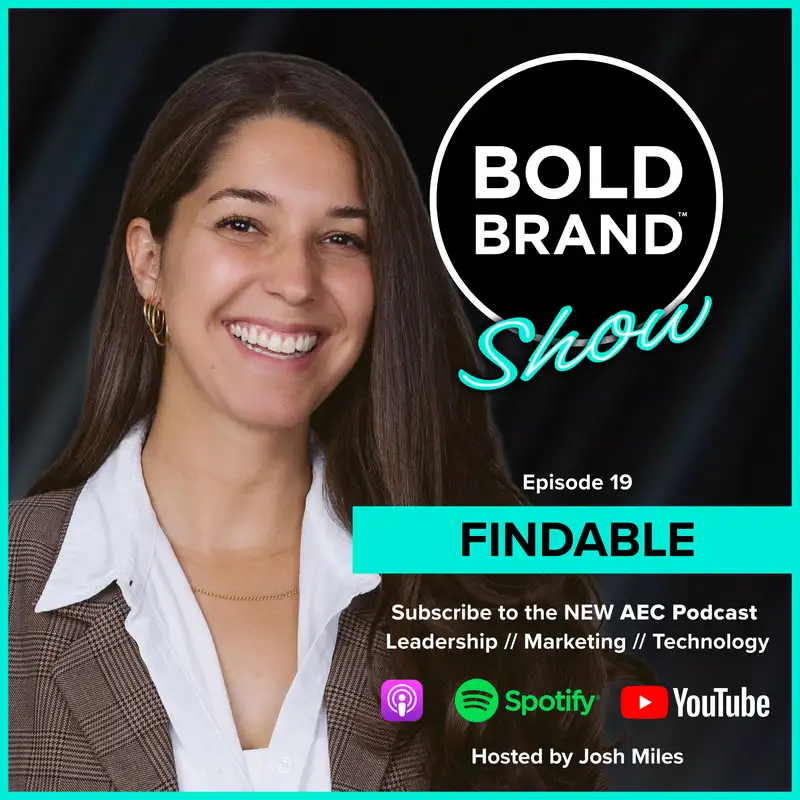
Welcome to the Bold Brand Show.
On today's episode, we're chatting with
Daniela Furtado, founder and CEO
of Findable Digital Marketing.
Uh, as you might imagine,
Daniela found me on the internet.
Findable is a digital marketing agency
built for the design and
construction industry based in Toronto
and working with clients across
Canada and the US to help design and
construction firms get found online
by the right people, which in my
experience is not something most firms
have a lot of experience doing.
Based in Toronto, Daniela started
building websites at nine years old.
And nowadays she writes, speaks on stages
and consults with design and
construction businesses to
grow with digital marketing.
Daniela, I always enjoy chatting with my
fellow marketing professionals
who focus on the AEC space.
Um, there's not that many
of us, but it's always cool.
We, uh, you've done a great job of like
keeping a regular chat on the books
between you and I every couple of months,
but it's awesome to have you
actually on the podcast.
So welcome to the bold brand show.
Thank you so much for having me.
I'm excited.
This is my favorite topic.
Some of the things that I think might be
fun to dig in today are of course,
your business, your backgrounds, things
around Google search and other search
engines, but also maybe get into a little
bit of the AI side of search.
And specifically you like myself have
built your business
around the AEC industry.
So I'm, I'm curious to hear a little bit
of your, your background of starting
findable and how you, how
you found yourself in AEC.
Mm-hmm.
It was very gradual.
So way back in 2019, I was working full
time for a manufacturing
company as a marketing manager.
Love the company, but
frustrated with the pace of it.
Um, and so I started dabbling with
freelance on the side.
And my first ever clients were a
landscape architect and a cannabis
e-commerce company to very, very
different companies.
But over the years, I got more and more
referrals from those respective clients.
And by the time it was 2023, 2024, um, I
started to realize that almost 50% of my
clients were either cannabis or
landscape, um, or architects.
And so around that time, I decided to go
all in on the architect, design, and
construction
industry, or the AEC industry.
Well, tell us a little bit more about
findable today and your team.
Yeah.
So we are a team of
five, including myself.
Most of us are in Toronto, Canada, but
we've got one teammate to North Carolina.
And we started off specializing in SEO
and since last year added social media
to, to our roster of services, all of our
clients are either architects,
interior designers, and
construction companies.
And we help them.
We make them easy to find online.
So as most of our case studies are best
case studies, you'll
see that we've either
doubled or quadrupled the number of leads
that are coming towards them.
And that really helps their
sales teams meet their quota.
Well, Daniela, before you get too far, I
think it's fascinating how you've told
me this story a couple of times about how
you really started to scale the
business and making your first hires sort
of unconventional way.
Maybe you could fill our
audience in on that story.
Yeah.
They often say, if you got hit by a car,
would your business run without you?
And that exactly happened to me.
So, uh, back in 2021, I was crossing the
streets going for a walk and I got hit
by a car and, uh, shattered my wrist.
I had what the paramedics
called an S shape to my wrist.
And so.
Couldn't work, couldn't type.
And luckily that was the only thing that,
uh, the only injury I had, it
could have been a lot worse, but yeah, I
went to the hospital.
I had emergency surgery.
I was in a cast for several months.
I was in and out of the
hospital doing, um, rehab.
And around that time I had signed on a
handful of new clients and thought, okay,
how am I going to do this work?
And so I didn't plan on hiring an
employee, but
circumstances pushed me to do it.
And so I hired Philo.
Philo is still with us or
Philomena is her, her full name.
At the time I needed someone that could
do a little bit of everything.
So I, the job description was called, I
think, digital marketing assistant or
coordinator, and it was literally a
little bit of everything that you did.
A little bit of, uh, the copywriting, a
little bit of website maintenance, um,
a little bit of analytics and a little
bit of client reporting.
And so, um, Philo applied.
She was a makeup artist at the time.
And she was
freelancing as a makeup artist.
So she learned the skills that are
required to promote your own work.
So she had made her own website and put
her portfolio and did social media
and did all the things.
And she had a little bit
of a nerdy side to her.
So she would often get in rabbit holes,
figuring it all out.
And, um, and then the pandemic head, and
she lost a lot of her makeup, uh, work,
but she was doing makeup for influencers.
And so they hired her to do
digital marketing support.
So by the time she applied, she had like
a pretty good portfolio of work.
And, um, I hired her and taught her
everything I knew those first few months.
And we would do check-ins.
And I remember the three month mark, she
goes, really like working for you.
I like the clients.
Um, I hate writing though.
I hate anything that's creative.
I love the technical part and I love to
learn more of that
and not do the creative.
And I said, okay, say less.
I'll hire someone to
do the creative parts.
And so over the years, the company has
really morphed around her.
Um, she was doing project management and
client communication at one point,
which worked in the beginning, but then
as the company got
bigger, I think I can't
remember if it was one or two years in,
she goes, uh, this is too much.
Like I hate, this is now too much admin,
too much client communication.
Again, I said, say less.
And I hired a project manager.
So yeah.
Thank you.
Philo.
Yeah, that's awesome.
Um, you know, in the, in the tech
industry and in
software and even in digital
marketing, a lot of times they use the
term like eating your own dog food, uh,
you know, using the software and using
your own techniques
and, and maybe this is
a dumb question, but you know, you're,
you're based in Toronto.
I know you've got clients in the, in the
United States as well.
I'm curious where, where
findable finds their clients.
Like how do, how do clients find you?
Yeah, we really walk the talk.
So about 30 to 40% of our clients come
from Google and then
the other, or another
30 to 40% comes from referrals, but not
in the sense that you would expect.
Um, they're not like clients recommending
us to people, although that happens.
You usually not that much because we
specialize in the AC industry and our
whole service is making you easy to find,
especially on Google.
They don't want to refer us to their
competitors because it's a conflict of
interest and they'd be competing on the
same page for Google.
Um, so when I say referrals, it's
actually people like you that I meet on
LinkedIn or going to networking events,
predominantly LinkedIn, and then we
maintain a relationship and sometimes six
months or 12 months or two years later,
they end up passing
on our referrals to us.
Um, so it's like, it's like
social media slash referrals.
Like they kind of go hand in hand.
Yeah.
And then the remaining
amount is public speaking.
So I do a lot of workshops
and speak at conferences.
Very nice.
And you've just started doing some, uh,
webinars too, that I've had
a chance to sit on a couple.
Yeah.
Yeah, exactly.
Uh, you know, as a brand new guy at
heart, uh, how would you say the digital
marketing piece, especially the search
marketing piece, how does that
compliment brand or do you find that
that's difficult to get those two
to work alongside one another?
Oh, they really compliment each other.
So I think it's so much easier to do
digital marketing, whether it's social
media ads, and especially SEO, when you
have very clear positioning.
If you're a company that does work in all
kinds of industries and all kinds of
markets, it's really difficult as a
marketer to figure
out where to prioritize
and, you know, which
who we're speaking to.
Um, so it definitely makes it easier to
put together and execute a marketing
strategy when there's very clear
positioning to begin with.
Um, and then having a clear brand also
makes it easier to convert internet
strangers into inquiries.
People I've noticed all time and time
again, the clients that have really
strong brands, their,
their image is polished.
They have good headshots and photos.
You can really get a sense of what the
personality is like in the company.
Just from visiting their website with
those companies typically see higher
conversion rates from
their website traffic.
You know, I'm thinking about especially
firms in the professional services world.
Um, you know, like you, we've, we've done
a lot of work in architecture,
engineering, construction.
And I'm starting to branch out a little
bit into the world of, um, subcontractors
and other, other related services.
And especially with those firms, I'm
finding how little digital footprint
some of these firms have that outside of
their website and maybe a, a
poster to on LinkedIn,
there's just not much there.
So maybe without asking you for any
secret sauce or
anything, if a, if a firm's
finding themselves in this place, we've
been around a long time, but we just
don't have much of a digital footprint.
Where would you really
encourage them to start?
Yeah, we have a
client like that right now.
She's been in business for 35 years and,
uh, has tons of leads coming in.
She's fully booked out
for the rest of the year.
Um, but she's interested in doing digital
marketing because she wants to sell the
company and so she needs to have leads
coming in, uh, that don't know who she
is on a first name basis, right?
Um, that's typically something that
sellers or sorry, buyers want to see.
Um, and then, and marketing her is quite,
uh, a unique case cause, uh, she's got
all these competitors online that have
been around for a fraction of, you know,
what she's been around for.
They've been around her competitors have
been around for five years, but they've
invested so much into digital marketing
that they are everywhere online.
And you know, it's like getting her on
the first page of Google is really
challenging because her credit score with
Google is almost non-existent yet.
She's been in business for 30 years.
She has a much, um,
more robust portfolio.
So yeah, it is, it is a unique challenge.
Um, so I would say the super low hanging
fruit in this scenario is Google maps.
Oftentimes these established companies
have something that their young
competitors don't have,
which is a physical location.
They've been around for a while that they
usually have an office.
And also they have a lot of testimonials
and that their competitors don't have
because they've just
been in business longer.
And so you could really
leverage that with Google maps.
So it's called local SEO.
So you could create a
Google maps listing.
You could use your physical
address as a, as a location.
And you can go back to all your clients
in the past year or five years, depending
on what your relationships are like with
them and ask them for reviews.
And if you do that consistently, if you'd
like, make it a task to ask three
people every week for the next three
months, you'll probably get so many more
reviews and all of your competitors and
outnumber them that way.
And then you can kind of jump up, uh,
Google, for example, if we're
talking about Google, just doing that.
Is that something
you've better don't have.
They usually don't have a physical
location and they don't have a
hundred clients to ask reviews from.
Yeah.
That Google maps thing can be tricky.
I know one of my clients just realized
their, their address on Google maps
was like two offices ago or something.
So just even getting, getting the reins
back of controlling that
information and getting it updated.
Yeah.
There are there any, uh, any hot tips for
managing your Google maps?
It's not a complicated,
it just requires nurturing.
So it just making it a task every month
to look back, whether it's you
or you delegate an assistant to do it.
Um, keeping the photos up to date,
replying to all the reviews.
If you've had some bad reviews, go get
some more positive ones to dilute or,
or drown down be those negative reviews.
Just keeping of all the
digital marketing channels.
If you compare it to social media, your
Google maps profile can have so many
more results for you with such minimal
effort, if you just dedicate an hour
a month to it, maybe shifting gears a
little bit to the AI world.
And maybe we spend a lot of time here
eventually, but, um, you know, I just
recently made mostly have switched over
from chat GPT to cloud.
I still kind of bounced back and forth,
especially when I'm working on.
Copy editing and things like that.
Like that doesn't sound right.
And like, try it again somewhere else.
How should AEC firms be thinking about
these platforms, especially
when it comes to being found, you know,
it's not exactly the same thing as,
as ranking on page one for Google and
kind of the, the
context is all very different.
So how could firms be thinking about kind
of this wild West territory?
Yeah.
There's two ways to look at AI, right?
Like on one way you're thinking about how
can you integrate it into your workflows?
And then in the other side, you're
thinking about how
can AI site or recommend
my company to other users that are
searching for specific prompts?
Um, and that the later is called.
GEO generative engine optimization.
So it's like the S SEO and AI combined.
And I actually went to a conference
hosted by Google Canada a few weeks ago.
Specifically about this, they, they
brought SEO specialists across the world
working at different Google locations and
to Canada to host a seminar.
They, I think they have 500 applications.
You had to apply to attend to this event.
Oh, that's cool.
Yeah.
So 200 people were accepted and
unfortunately findable was one of them.
And it was a really cool event.
Really, really cool.
Um, and, uh, Danny Sullivan was one of
the speakers talking specifically
about GEO or AI SEO.
Everyone has different ways.
You, some people call it LLM SEO, GEO,
AEO, SEO, AI, AI, AISEO.
We haven't quite figured out as an
industry of what to call it.
Yeah.
Um, but Danny Sullivan was, was, um, Was
on stage talking about it.
And he had this one slide
that said, good GEO is good SEO.
And the whole room, you could hear them
relieve like sigh and relief.
Finally someone like said it.
Um, and I think he even got in a few
claps because you were so
relieved because there are marketers in
the space that is, that are really, um,
taking advantage of this trend and making
it sound like it's a separate
service, a separate strategy and using it
to upsell or charge more to clients.
Like I heard, I had a lead come through
saying, uh, we have an SEO company,
but they don't do GEO.
So we're looking for a
company that does GEO.
And I thought that's ridiculous.
Like there's no such thing, but yeah, a
lot of people, a lot
of people think that.
So yeah.
So sorry to answer your question.
Um, GEO is just good SEO.
It's a more, it's thinking
about how SEO is related to other
marketing channels,
like social media and PR.
Um, but it's really not all that
different from, from
having just a plain old
basic good SEO strategy and we can talk
about it into depth.
Sure.
Um, I could nerd out on that probably for
two hours just by itself.
Um, so thinking about, you know, I, I had
my first ever pure GEO lead a couple,
maybe it was a month or two ago now, um,
which didn't end up converting,
but it was a dead on lead.
So it was, it was somebody in the
software space that worked with
the AC firms and they were looking for a
fractional CMO who specialized in
the AC and has experience in software.
Like there's not very many of me.
I was like, yes,
that's exactly what I want.
Um, so it was, it was really interesting
to find, you know, I, I was digging
into how he found me cause I
didn't know the guy for me.
A lot of my work comes from, uh,
referrals or speaking
gigs or things like that.
And so when, when it doesn't happen that
way, I'm always really curious how they,
how they found me and it was kind of, uh,
like, like the best kind of referral
you could have gotten from a friend is
what chat GPC had to say about
me for his particular needs.
So it was like, man, how do, how do I
replicate that more?
Um, how much do you think, and I'm sure
this is changing all the time.
So maybe some of this is like guessing as
much as it is actual science, but how
much of it do you feel like is, is
happening from on page strong SEO
signals versus all the external social
and other supporting things that are
really helping AI
figure out what to tell you.
Yeah.
Actually, can I answer this question by
asking you some questions?
Oh yeah.
Yeah.
And using you as maybe a case study and
dissecting your situation.
Okay.
Yeah.
Yeah.
Lead that came through, was he local?
Do you know?
No, he was not local.
He was in a different state.
Yeah.
In a different state.
Yeah.
I think he was in New York.
Okay.
Okay.
So, uh, sometimes chat GPT has a
preference for citing
to giving you local,
it can be quite localized,
but in your case, it wasn't.
Okay.
And, um, okay.
So he, he found you on chat GPT because
he was looking for a
fractional CMO support in the AEC space.
Um, have you ever created content saying
that you do fractional CMO work in the
AEC space online, anywhere online?
Yes.
It's, uh, first and foremost on the
website and on LinkedIn and probably
podcasts and other
things talking about it.
Right.
So you're putting out podcasts, which
then get on YouTube
and I suppose Spotify,
Apple music, or all
the, all those platforms.
So you, so that's one area
where you're talking about this.
Uh, you do put
transcripts on your website.
Typically.
Yes.
You're talking about it on social media.
Do you have a reviews anywhere?
Uh, that's a great question.
I don't know that I, um, I don't know
that I have any reviews anywhere.
Are you on any directories?
I know client AC, uh, industries
specifically on like house or home
stars, if you're a
subcontractor, not everyone.
Yeah.
Yeah.
I don't think, I don't think I'm on any
of those kinds of platforms either.
Maybe, um, you know, my, my book is on
several book platforms.
Oh, there.
Reviews for the book.
I mean, okay.
That's a big one.
You've got a book.
Yeah.
Okay.
And how about, um, we've talked about
directories, content that you put out
testimonials, what about, um, are you
part of any communities, like a chamber
of commerce, um, any associations?
Have you, and, oh, sorry.
I got another question.
Have you gotten any, do you have any
certifications or awards?
Yeah.
Yes.
All those things very involved in S and
PS and a couple other groups and.
Right.
Search and awards.
Yeah.
And the through line among all these
things is that you consistently come up
as the branding guy, the
marketing guy for the AC space.
Yeah.
Yeah.
Yeah.
That's right.
So that's, I mean,
that's, that's the secret sauce.
That's the formula for you is that you
come up consistently on all the online
platforms, the book, the podcast, the
social media channels, the YouTube
videos, the website,
um, any type of PR, right?
Like directories, associations, awards,
online magazines, other interviews.
You come up consistently online.
So you have a very
strong digital footprint.
And when you come up online, you're very
consistent in how you introduce
yourself and who you're speaking to.
And AI search understands that.
What it does is it looks for patterns and
it, and as when you come up consistently,
it makes it super easy to understand the
pattern, the through line, and then
figure out who is best suited for you.
What we haven't quite figured out is, um,
like how to measure the
prompts the way we can an SEO.
So like an SEO, we can, we can distill
the language people are using
and we call them keywords.
And then we have tools to estimate how
many people are
searching for this keyword
per month and because AI SEO or geo is so
conversational, like you can ask 10
questions in one prompt or you can have a
whole conversations and then full of, uh,
like it could be a voicemail, right?
It's, it's, we're not able to, to work
backwards and figure out what's the
common prompt that people
use to find someone like you.
But if you think about, um, how you show
up and ask yourself, is it consistent?
And is it frequent?
Um, then you can kind of reverse engineer
how chat to BT or any of the AI
search tools are going to
find you and, and cite you.
Yeah, that's really interesting.
Um, I don't remember whose research it
was, but I remember somebody having
done research on the
same question multiple ways.
Spark Toro.
Uh, yeah.
Okay.
Yeah.
I was, uh, Rand, right?
Rand.
Yes.
Yes.
Um, so he did the study on all the, the
consistency, maybe
talk to that a little bit.
Yeah.
I hope we're more citing it correctly,
but they did a spark
tour is a really great,
um, platform.
They do a lot of research on, I think
they call it like social media
listening or online listening.
So they, uh, pay a lot of attention to
how people are using the internet.
Um, and it's a software as well.
But anyways, he put out this, um, him and
his team put out this research
paper comparing, if I use the same prompt
on Google and on chat to BT, how
consistent are the results?
And I can't remember the numbers off the
top of my head, but it was something
like, um, for every like 200 searches on
Google, you'll get the exact same 10
results in 146 of the 200
with some number like that.
It may not be always in the same order,
but you'll see the same websites come up.
And then on chat to BT, it was something
like, like six out of a thousand
or something like that, like it was such
a huge difference in ratio.
And that really speaks to how
personalized, um, the results are on AI.
Yeah.
So is that, is that more about the users
context and things that they've
asked chat and the back in the past, as
opposed to it not being the right answer.
Right.
Exactly.
Until oftentimes I'll speak to people and
they'll be like, Oh, I asked chat
to BT, you know, which contractor in
Chicago they recommend who's the best.
And they said me, it's like, well, you've
probably told chat to
BT that you are the best.
He probably knows a lot about you.
It's just agreeing with you.
Yeah.
Um, so it's something you kind of touched
on in passing was the PR piece.
And, uh, I'm curious, you know, PR is so
different in 2026
than it was even in 2006,
2016, um, where, where from an, really
from an SEO perspective or from an
SEO and GEO perspective, what do you feel
like are the strongest, uh, ways
to, to use PR to elevate getting found?
You know, there's, you can pay for the,
the blast that goes out on all these
links and like so many
other ways to, to get PR today.
So just curious, your, your
input from a SEO perspective.
Yeah.
So, um, in the traditional SEO world used
to buy, and I mean, I used to, there's
some people that do this, you used to buy
backlinks, so you would pay a website to
link back to your site.
And if you do enough of that, Google
starts to clue in
like, oh, okay, a lot of
these links are pointing to this site.
I should, you know,
rank this website higher.
And, um, we don't know if AI search tools
hold a lot of weight on those paid
backlinks or if they even
know that those are paid.
Um, we do know that the frequency and the
authority of the websites matter.
So getting, I don't know, I'm going to
come up with random numbers, 50 links
back to your site from teeny tiny
websites that nobody has ever heard about
is maybe the same quality or less than
getting one link from architectural
digest, it's a high authority website.
It has a lot of brand
and credibility behind it.
It's getting a lot of their traffic and
it's relevant if you're an
architect or a designer,
it's relevant to what you do.
So relevance is also important.
Um, yeah.
And I guess as I say, all of this, I'm
realizing if this, but getting linked
back, right, like that's, I think another
big difference before in traditional SEO,
you had to get links back.
Like there had to be a hyperlink for it
to have any sort of validity in the SEO
world and now touchy
BT is smarter than that.
But even if it doesn't link back to you,
as long as the name, you know,
your name is there, it gets it.
Is there anything else related to PR that
you think is, is valuable besides,
you know, having that, that one important
site that's talking about you, you know,
so let's, let's think back
to a more traditional thing.
You have an announcement or a thing that
you want to talk about online and you
want to have the press look at it or you
want, you want to get the word out.
Like what, what would be the more
powerful way to look at
that from an SEO perspective?
I think it's limited SEO.
I think it's just, again, having a
holistic approach to marketing is,
it comes back to positioning.
Like think critically about what you want
to be known for, what kind of
projects you want to attract and get
pressed that it is in sync or in aligned
with that, I think it's really confusing
both to algorithms and to people when
you're all over the place, like you've
got press for doing medical clinics.
And then you also, the next month you get
press for designing multifamily homes.
Right.
It's really difficult for people and
algorithms to understand who are you
and what do you do?
Maybe, maybe zeroing in
back on the AEC market.
In my experience, you know, my running
joke is if you want to know what the
future of AEC marketing looks like, just
look at what everybody else is doing
right now, and that's where
we'll be in a couple of years.
It's just usually a couple of years
behind, you know, that, that is not
as true as it used to be.
I don't think we're as far behind in AEC
as we have been in the past.
So that's cool.
But, but what do you think are some of
the more common mistakes that AEC
marketers are making, especially when it
comes to, let me say that differently.
What are the mistakes that AEC firms on
the whole are making that digital
marketing might be
able to help them with?
I think the AEC industry, more than any
other industry is not very good at
taking a data driven
approach to marketing.
I'm surprised with how many people do not
track their leads and not to say that
your, your lead tracking has to be a
hundred percent correct, but they don't
even have the practice or the habit of
asking, how did you hear about us?
And kind of be
curious about the backstory.
Um, you know, I'm not saying you have to
track it super diligently on a, on a
spreadsheet or a CRM, but like how that
practice and how that curiosity to know
where work is coming from.
So that, that I would
say is, is the biggest.
And when you don't have that, it really
has this domino effect to everything else
that you do.
It means that you typically don't have
realistic expectations about how
different marketing channels work.
For example, like you've got this email
newsletter and you're disappointed that
you're not getting new
leads from the email newsletter.
That's not what email
newsletters are for.
They're supposed to nurture the people
that already know about you, not bring in
new faces or, um, I often hear people say
like, you know, let's post the new blog
posts on, uh, social media.
And that's just not how people on social
media use social media.
Like they don't want to leave the
platform to go read your blog posts.
The blog post is meant for SEO and to get
on the first page of Google.
You can then chop that up and make them
into social media posts, but
expecting your, you know, your followers
to go read your blog posts is not
realistic and it really shows that you
don't understand how people use the
internet and how they find you.
Um, and yes, we can have social media,
like people posts then bare minimum.
They post maybe like once or twice a
month and it's barely, barely post
pictures of their team and, and the face
of the faces of people in the company.
And then are disappointed
that they don't get any leads.
It's like, well, you're not consistent.
You're not putting yourself out there.
People go into social media to connect
with others, not your logo.
So yeah, those are, those are a handful,
but I think it all starts from not
tracking your leads and not take, not
being curious about how people find you.
You don't do that.
How's this?
It shows up in all your, your marketing.
Is there anything else, um, AI software
technology that, that findable is using
or, uh, you think has been especially
helpful kind of connecting the dots
for AEC firms?
Um, so we use AI a lot to help us come up
with strategies and the first or
second draft of
writing anything quite a bit.
Um, we're being testing out, um, AI tools for, for, for, for, for, for, for, for,
for AI tools to track analytics and are
quite disappointed to be honest.
The technology is not just not there yet.
However, uh, someone on our team, Philo,
the person I mentioned earlier, she
actually coded it an app over the
weekend, a few weekends ago.
Um, and so she sinks it.
What she did is she built this app that
is connected to all of our
analytic softwares, and then you could
prompt it and ask, tell me how this
social media or website traffic has
changed over the past 90 days.
And it just pulls it for you instead of
you going to manually to each dashboard.
So that has, that's
been, um, how we've used it.
And me personally, I've been
using AI a lot for paid ads.
Like I love it.
Well, tell me more about that.
Well, it depends which, um, platform
we're talking about.
So, um, well, it will help me set up the
camp campaign much faster.
Like I used to have to hire a contractor
cause it was so much manual work or there
was so much, uh, so much to learn, like
the learning curve was so steep, but now
I can take screenshots of the campaigns
that I'm building and plop it into AI.
And it will advise me
as I'm building it out.
It'll make it much easier for me to put
out, because you know, when you build an
ad campaign, you got to create like,
let's say a dozen different ad sets to
experiment with and that's pretty
meticulous until AI can help me write
those cop that copy much faster.
Um, and then just the algorithms now are
so much better at
targeting, uh, than ever
before.
I know when, when I first started playing
around with paid ads on Google was when
I was on staff with S and PS and, um,
gosh, I would, I would create an ad,
create an ad set and
then it wouldn't run.
And I wouldn't know why it's like,
especially Facebook ads, like it was, you
know, you'd think you'd the stones
starting to roll down the
hill and you go back and
it's still sitting at the
top of the hill two days later.
Like, I don't, and it doesn't really do a
great job of telling you why.
Something I've learned with, um, paid ads
is that AI is much better at targeting.
So it's much better at putting your ad in
front of the most relevant people.
Also because it has so much data on users
on user behavior nowadays, but you,
it, that's also made creative so much
more important, so much more important.
Um, you can't just create a graphic.
I think you can on LinkedIn.
LinkedIn is pretty
behind compared to meta.
Um, so, but, but on meta for sure, you
can't just create a graphic and use that
as an ad and call it a day.
You've got to be really creative.
You've got to have really excellent, um,
hooks and storytelling.
Um, that, that doesn't mean that the
production quality always has to be super
high.
You'd be surprised that a lot of low
production, um, videos do quite well.
They're, they're some of the best
performing ads because that's typically
what people want on social media.
They want it to feel real and
like native to the platform.
But yeah, I think like knowing who you're
speaking to, knowing what messaging,
what language clicks for them.
Um, and then captivating that in an ad is
so, is so important.
And then AI takes care of everything else
that the targeting, but if you,
you've got to get the
creative down, right.
And for the creative, it sounds like
you're employing a lot of the ads.
You're using video for the ads.
Yeah, I do use photos.
I've been experimenting with LinkedIn
and, um, meta ads, and
I find, uh, LinkedIn,
you don't have to use video and you can
still get just as great as results.
Um, and sometimes with meta, like usually
it's, it's good to have a mix, um, with
meta to have a mix of photo and, and
video, depending on what the ad is trying
to do, but yeah, generally speaking, uh,
on meta, it's heavier on the video.
Where would you say video fits in your
client's typical marketing mix as
far as the digital piece goes?
It all depends on the person and how
camera shy they are or where they're not.
It really, really depends.
I mean, if it were up to me, I'd love
everyone to be doing video, but if a
client doesn't like it, they don't want
to get in front of the camera.
Um, then don't, I don't bother because
it's just going to be a painful
process for both of us.
Are there any other, uh, major trends
that you're seeing in the digital
marketing space, good
or bad major trends?
I think, um, I don't know
much about the engineers.
I don't have as much
experience with them.
But when I think about architects and
tier designers and contractors, um, I'm.
I'm amazed.
I'm really excited to see how many are
turning on the camera, bringing an
iPhone to the job site and recording the
behind the scenes and the progress and
educating their audience, whether it be
an audience of 500 or 500,000, um, kind
of bringing people behind the scenes,
behind the build, I think that's a
really exciting trend and, um,
with that, I also see a trend.
Of a lot of DIY
renovators, you know, doing this.
And I think, I mean, maybe this is a hot
take, but I think when anybody is
creating content about what it's like to
build something, it,
it helps the industry,
whether you're a DIY or not, I think it
really helps the industry because a
challenge in this industry is
communicating the value of professional
services, communicating why you should
hire a designer and engineer a
contractor to do the work for you to
mitigate the risks, um, save money in
the longterm, have better
quality projects, right?
Like to help places that
balance both form and function.
And unless you go through the trials and
tribulations of building your own
space and you realize, Oh gosh, this is
such an involved process.
You don't realize what the value is.
And so, um, having more people record
videos and educate the public on that,
I think helps the entire industry, the
industry professionals.
I mean, are there any other industries or
maybe parallel industries to AEC that
you think is sort of getting it right or
that, that you would look to or refer.
AEC clients to go see like how they did
it over here to apply how we might
be able to do it in our space.
Oh, that's interesting.
That's a good question.
Um, it depends if you, okay.
I think there are, um, when we think
about like lawyers and therapists, they,
there are some stars in the industry that
do a great job of educating the
public about their professions, but it's
not a visual profession, right?
So if you want to see how people
articulate themselves
without the visuals,
I think they're good examples, but
visuals, people like it, I think artists
do a great job of showing the process.
There are so many artists online that
have grown a following just by
documenting the process of building, you
know, like of a painting, for example.
And then it builds anticipation and
they're more likely to get people
buying the final work because they saw
the process throughout it.
And it's very visual as well.
Um, so yeah, I think the, the AEC
industry can learn
from so many industries.
You just got to pick and choose, right?
And kind of make your own Frankenstein.
Well, he talks at the start about, you
know, kind of using the services
yourself, like using the same strategies
and tactics for findable.
Right.
Um, from a positioning standpoint,
especially how is findable standing on
the market, like what are you doing to,
to differentiate your firm?
The bar is quite low.
You know, um, there aren't a lot of
people marketers serving this space and,
um, so that helps.
Um, I shouldn't say that the bar is low.
Is it the pool is small?
I should say that.
Yes.
Um, so I think just specializing in AEC,
doing organic marketing in AEC
is like enough of a differentiator.
Um, and then beyond that, I'd say it's
how processing data driven we are.
Um, some other things, like I think being
not too small, not too big isn't,
is a great asset as well.
We're not like a hundred person agency,
but we're not a solopreneur.
So for a company that wants,
um, to, to tap into different
skill sets of a team that could be,
depending who they are, that
could be an advantage.
Um, and, uh, our approach to marketing is
really, like it's a hybrid.
Like we understand how relationships
driven this industry is, and
we're not trying to ignore it.
We like embrace it.
So for example, I tell all of my clients,
you got to get good photos
and videos to use on the website.
Right.
So we're making a website for you or
we're not making the website.
We're marketing the website for you.
Um, and so we're doing, we're leaning
into the digital, but we need to still
have those human components, right?
Like having your photo on the homepage
or, you know, let's do social media,
but let's use video and really show your
personality, or let's integrate an
email marketing campaign or email
marketing into your marketing and sales
strategy.
So every time you go to a conference, uh,
get those emails and put them in the
email list, or every time your sales team
speaks to someone, get the consent
to put them on the email list, like
really, um, is that clear?
Like integrating the in-person and the
with the online, like I think that's,
that's how marketing must
be done in this industry.
Yeah.
It's amazing to me when, you know, I
think most firms would say how important
relationship is to them as a firm.
Um, if we get in the way back machine and
look at everybody's website from even
10 years ago, there are almost no faces
in the photos of the buildings on the
websites and you might get a team page
with a grid of the principles, but
that's, that's about it.
So, um, I always say that one of the
biggest untapped, you know, hacks for
relationship is how you introduce your
people ahead of the actual introduction.
So we, we certainly don't have time to
go, to go meet every possible client, but
you could make it possible for every
client to virtually meet you before
they ever reach out.
And I think that's a
huge potential advantage.
That's just kind of left
on the table at most firms.
Yeah.
That reminds me, there have been so many
situations, but one situation stands
out was this interior design firm of 30
people, they reached out to me looking
for consulting support.
They were putting out a new website and
they wanted to get a second pair of eyes
to look at the website
from an SEO point of view.
So that the moment that they had
published the website is, is optimized.
And, um, I just can't help, but like
comment on other things that are not
related to SEO, but
still relevant to marketing.
And they kept repeating to me, like, you
were a big firm, you know, we, we've
been around for 15 years and we, we, we
have a great team and they kept talking
about the size of the
team, how great the team is.
I didn't see the team
anywhere on the website.
I just saw the picture of the founders.
And I'm like, honestly, if we, if you
didn't tell me that part, if you
omitted that from our conversation, I
never would have known that I would have
thought that you were just
two ladies designing homes.
Like I would not have thought that or
picked up from your website that you're
actually an established company with a
studio and you know, a 30 person team.
And, um, and yeah, and then they ended up
taking photos of the whole company.
They didn't take individual shots, had
shots, but they took a big group photo
and put it on the website
and I'm like, there you go.
That sends such a different message.
Well, I think first and foremost in our
space, that website is,
is usually a validation tool.
So they either replied to an RFP or they
had a, uh, a referral or they
saw the logo on a sponsorship banner for
the little league team, you know,
some, there's all these different ways
that we get introduced to firms in this
space, but the website is not, you know,
clients who bought this also bought
that click now to download construction.
Like you don't buy that way, but you do
go there to say, is this the firm that I
heard about, do they, do they kind of
pass the sniff test and most, most firms
don't do that very well either.
Yeah.
Yeah.
So well said.
You know, the, the biggest pushback that
I hear, this is your last hardball
question before we, uh, get to your,
your, uh, big predictions here.
Um, the biggest pushback that I get every
time that I pitch paid digital
marketing in a EC is, is
that whole thing, right?
That it's, it's relationship.
Nobody's going to search for, for what I
do because it's so specialized.
Nobody's searching there.
Do you know who we are?
You know, it feels silly to pay for it.
You know, that what do you say to that
sort of pushback that is like, it's
all relationship, it's all proposal.
It's all bid.
It has nothing to do
with being found online.
Sometimes that's true.
Um, for paid, I mean, um, again, kind of
going back to what I would say in those
situations is to go back and think about,
um, where your leads came from.
What was the first and
the last touch point?
And, and then that can help, um, open up
a conversation, but like, okay, well, if
we had done, if we do more than that, if
we doubled down on that one touch point,
imagine what could come out of it.
And again, like adapting the strategy to
how consumers actually purchase.
So like, okay, we have one client,
they're a billion dollar company.
They get all their work from RFPs and
they've got a whole sales team
that it's like going to conferences,
taking people to dinner, going, doing
coffee checks all day long,
like that's the whole job.
So they're not going to get
leads from any of our work.
That's not, but that's not
the purpose of our, of our work.
Like, you know, I think it's comes down
to like defining success differently.
Just because other companies get leads
from digital, it doesn't mean that's not
how you, it doesn't mean that you have to
operate the same way, but that also
doesn't mean that digital doesn't have a
place in your business because
everyone is online, that we're also in
person, you know, but we're also living
online. And so in this client's
situation, what their
sales team have said is it's
much easier to get yes to a second
meeting when we have a
strong online presence,
because like we take someone out to
dinner and then after the meeting or
something or before or jury, they're
going to our website, they're checking
our social media. And if there's
something on our
social media that resonates
with them, then it's much easier to go
into like, they bring that up in the
dinner, it's a conversation starter.
And then it's a lot easier to get them to
say yes to a second meeting when they're
following you on social media
and you're like top of mind.
So like, that could be, you know, you've
got a video series on your Instagram or
your LinkedIn where you're interviewing
people on the team in the company that
have been around for a while and what is
their favorite things
and some of them are
funny, right? Or it could be like thought
leadership pieces about the industry and
where it's going. And like that could be
something that could be a conversation
starter with with those leads. So you see
how what I mean,
like, we're not expecting
digital to bring in the lead, but we're
creating a digital marketing strategy to
support the sales team to
nurture the leads, right?
We're marketing in this case is
supporting the sales team
with what they're currently
doing. And then other
companies, it's the opposite.
I mean, it's not the opposite.
It's a little bit different.
Like we're trying to bring in inbound
leads to pass on to the
sales team and then it's
on the sales team to nurture and close.
You're not an e-commerce.
So paid ads is not going to be like
click, you know, so like
people are buying shoes
and then like tap and then they add to
card and that's it
like, yeah, yeah, right.
Like it adds can work, but it's not it's
you got to like figure
out how it actually fits
in your sales process.
So paid ads can work to get people on
your email list, you
know, like you publish a
white paper and you use ads to promote
the white paper and it
help, you know, you're
going to do it organic probably, right?
You're going to do an organic post on
LinkedIn or an again,
you're going to create a
landing page and optimize it for search.
So you'll probably get downloads
organically from your
white paper, but if you put ads
behind it, you can expand the reach and
get even more people downloading.
And so use ads to promote the link, the
white paper, the magnet, for example.
And then you've still got to have like an
email sequence or a
salesperson that's following
up with the people that download.
So you still got to
have the relationship.
Like digital does not replace the
in-person connection
or the human connection.
It just helps amplify it or speed it up.
Reminds me of a thing that
Jay Baer says all the time.
He's a digital marketing keynote speaker
guy also from Indiana.
But he outside of being a really smart
guy, he's a really good enunciator.
So he would always say you
have to market your marketing.
It's like having ads to promote the
marketing that you've already built.
You've already got it out there.
Like, why not throw
gasoline on that fire?
That's something I think that I don't
always think of all the
time for my own stuff.
Like, oh, what about paid ads to promote
my own stuff that's already out there?
Yeah.
Yeah.
I actually, I put out a LinkedIn post a
few weeks ago, just saying every Thursday
I put out an email
newsletter, we cover these topics.
Readers come from these companies.
If you want to get the next one,
subscribe here and
I've got a photo of me.
Super basic.
Like it took me less than
five minutes to put it together.
And on the first day I got 15 new email
subscribers organically.
And I thought, hmm,
what if I boosted this?
How far can I take this?
So I boosted it for $10 a day for 30 days
and I got a hundred
new emails subscribers.
And I was like, wow, I didn't even have
to do, I didn't have to do a lead magnet.
I didn't have to do a whole campaign.
I had to record a fancy video.
It was so much simpler
than what I anticipated.
Why don't I come up
with more ideas like this?
Well, hey, before we wrap up here, it's
time for your bold
prediction for the future.
So if you want to dust off your crystal
ball, you can tell us
what your, your bold
prediction in AEC marketing looks like or
in digital marketing could be.
Anything, any topic you
feel passionate about.
Okay.
I don't know if it's a prediction because I think it's happening right now.
I predict that we're going to see a lot
more personality in the AEC space.
I think we're going to see a lot more
people putting their
faces on their website,
creating more videos on social media,
having more personality in your copy.
Maybe that's wishful thinking and not a prediction.
I also like to see that more often. Yeah.
I just see so many, many firms paying
more attention to digital marketing.
I'm often surprised with the kind of
people I meet on my sales calls.
I'm like, Oh, okay.
You don't seem like you know much about
digital, but the more we talk, I realize,
okay, you know, quite a bit. Like I can see that the, the more I'm going to see that the more I'm going to see that the industry is educating
themselves more and developing opinions
and is more open to it.
And that's so different than when I first
started in this industry back in 2018,
2019.
And so I predict that the industry is
going to be more savvy and have more
personality.
I think that's a great, uh, prediction and wishful thinking on my part too.
Yeah.
Well, Hey, tell our listeners where they
can find more about you and more about
findable digital marketing.
Yeah, you can find us a lot everywhere.
The website is findable,
digitalmarketing.com,
um, LinkedIn, YouTube,
Instagram, I think even TikTok.
Uh, you can find us there.
And, uh, I write an email
newsletter every Thursday.
I have a lot of findable, uh, digital marketing, uh, and, uh, I have a lot of fun
writing it, putting it together.
Um, not to brag, but our clients love it.
They're our most loyal readers.
So yeah, if you want to learn more about
me, join the email newsletter.
I, uh, will give a plus one
for the email newsletter too.
Lots of email is terrible
and yours is really good.
Uh, thank you.
Thank you, Josh.
Well, Hey, uh, I'm sure we'll chat again
here soon, but it was great, uh,
hanging out with you on the podcast.
And thanks for being on the show today.
Thank you.
I love talking show.
All right.
We'll see you next time.
Thank you for joining us today on the
bold brand show for all of today's
show notes and links to our sponsors.
Head over to bold brand.show.
Be sure to subscribe
to our email newsletter.
We'll update you on the
latest episodes and other exciting
things happening at bold brand.
If you liked today's episode, do me a
favor and share this
episode with a colleague
over at bold brand.show.
You can subscribe on Apple podcasts,
Spotify, and everywhere you get your
podcasts, including YouTube, where you
can watch full versions of each episode
and join the
conversation by commenting below.
The bold brand show is
produced by yours truly.
Josh miles and is a product of bold
brand, LLC, a branding and video
agency for ABC firms based in Denver,
Colorado, visit bold brand.com to learn
more or hit that orange button up top to
schedule a time to chat about
your branding or video project.
Catch us next time where we chat with
another bold
innovator in the AEC industry.
Thanks for listening.
We'll see you next time.